
Versions and Compatibility
How Bifrost reports its version, how the CLI verifies it's compatible with the API, and what to do when the CLI is too old.
Bifrost ships as three coordinated artifacts — the API server, the bifrost CLI, and the web client — and they need to stay roughly in step. This page documents how versions are surfaced and how the CLI guards against running against an API it doesn’t understand.
Release channels
Section titled “Release channels”| Channel | Tag or image | Intended use |
|---|---|---|
| Development | :dev |
Bleeding-edge builds from main. Expect bugs; the maintainer runs this channel first to find them before a release. |
| Release candidate | vX.Y.Z-rc.N |
Signed, versioned builds for operators who want changes sooner without tracking every development build. Candidates do not update :latest. |
| Full release | vX.Y.Z and :latest |
The stable production channel. Full releases are planned roughly monthly, with release candidates between them. |
Pin an exact version in production when you control rollout timing. Use :latest when you want each final release, and use :dev only when you accept continuous change.
Where the version lives
Section titled “Where the version lives”API server (BIFROST_VERSION env var)
Section titled “API server (BIFROST_VERSION env var)”The API container is built with a BIFROST_VERSION environment variable (for example, 1.3.0). At runtime, the API returns it from GET /api/version:
curl https://your-bifrost.example.com/api/version{ "version": "1.3.0", "min_cli_version": "1.2.3"}If BIFROST_VERSION isn’t set (typical for local development), the API falls back to git describe --tags --always --dirty from the repo working tree. If neither is available the version reports as unknown.
CLI (--version / -V)
Section titled “CLI (--version / -V)”bifrost --version# bifrost 1.3.0The flag short-circuits before any other CLI logic, so it works even when the CLI can’t reach an API.
Web client (sidebar / footer)
Section titled “Web client (sidebar / footer)”The version is printed in the user dropdown in the top-right of the app. Click it to copy the version string to your clipboard — handy when filing bug reports.
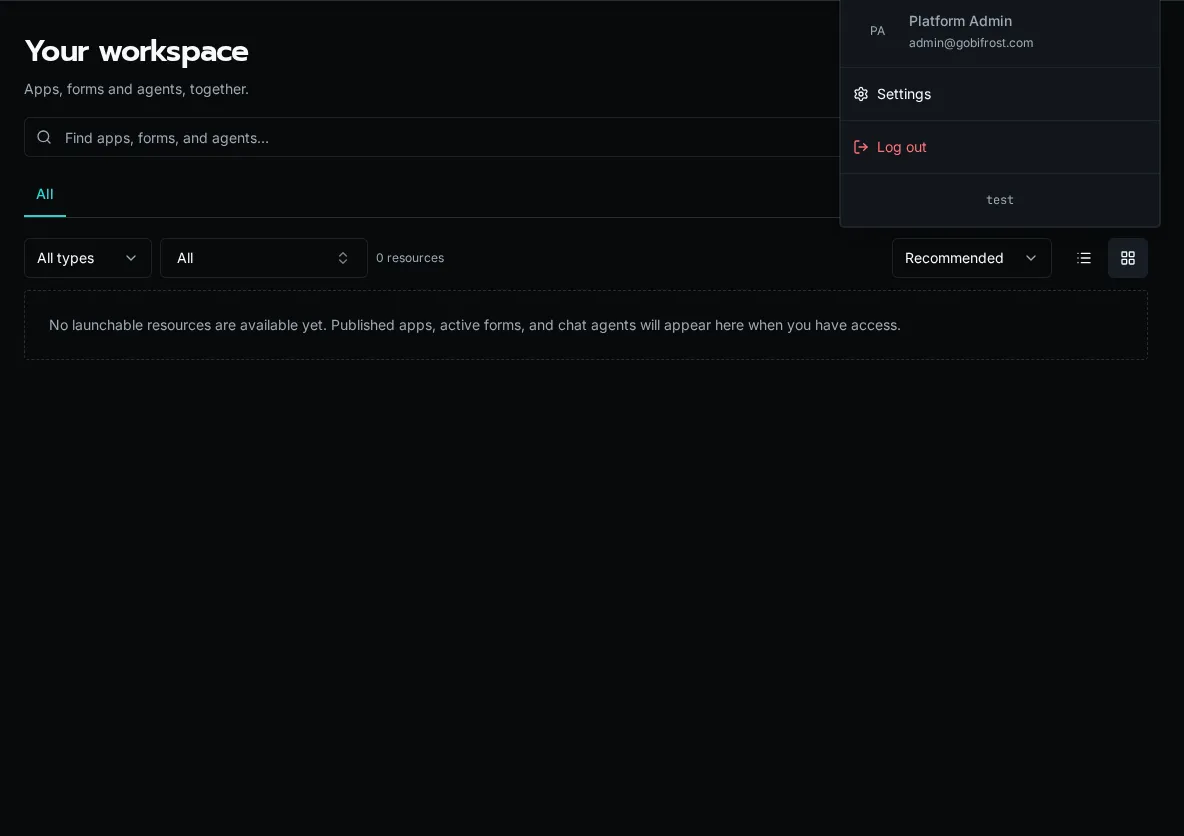
The client reads its version from VITE_BIFROST_VERSION at build time. If that env var isn’t set during the Vite build, the menu displays unknown.
CLI ↔ API compatibility check
Section titled “CLI ↔ API compatibility check”Every CLI invocation issues a fast GET /api/version against the selected API and compares the response’s min_cli_version to its installed version. A CLI below that minimum exits before dispatching the command and prints an API-matched upgrade command:
Your Bifrost CLI 1.2.2 is below this server's minimum supported version 1.2.3. You must upgrade: pipx install --force https://your-bifrost.example.com/api/cli/download/bifrost-cli.tar.gzThis minimum-version check is a hard compatibility gate. It prevents an older client from sending a request whose meaning or response contract changed.
Build drift above the minimum remains a soft notice: a compatible CLI may continue when the server is newer. If the server is unreachable or returns an unreadable version document, the CLI prints a warning and continues because it cannot establish incompatibility.
Upgrading the CLI
Section titled “Upgrading the CLI”bifrost updatePass --url when you need to update from a specific instance:
bifrost update --url https://your-bifrost.example.comAfter the upgrade, re-run with --version to confirm:
bifrost --version# bifrost 1.3.0Pinning versions in production
Section titled “Pinning versions in production”For self-hosted deployments, pin the same version tag across all three artifacts:
- API container:
ghcr.io/gobifrost/bifrost-api:1.3.0(setsBIFROST_VERSION=1.3.0) - Worker container: same tag as API
- Web client:
ghcr.io/gobifrost/bifrost-client:1.3.0 - Operator CLI: update from that API with
bifrost update --url https://your-bifrost.example.com
Mismatched API and worker tags will land you with workflows that compile but fail at runtime when the worker can’t find a method the API serialized. Always upgrade them together.
The GET /api/version endpoint
Section titled “The GET /api/version endpoint”This endpoint is unauthenticated by design — health checks, the CLI compatibility probe, and external monitoring all need to read it without credentials.
| Field | Meaning |
|---|---|
version |
Current API version (the value of BIFROST_VERSION, or git describe, or unknown). |
min_cli_version |
The lowest CLI version the API accepts. Commands from older released CLIs are blocked until the CLI is updated. |
min_cli_version is a hard-coded constant in the API source — it’s not configurable per deployment. To bump the floor, the platform release ships an API where the constant has been raised; downstream installs pick it up by upgrading the API container.
Troubleshooting
Section titled “Troubleshooting”bifrost --version prints unknown.
You’re on a CLI installed from a development checkout where version metadata was not baked in. Reinstall from the selected instance with bifrost update --url https://your-bifrost.example.com.
API reports version: "unknown".
BIFROST_VERSION wasn’t set in the container env and the working tree isn’t a git checkout (typical for production images). Check your Helm values / Compose file for the missing env var.
CLI keeps reporting that it is too old after an update.
Two bifrost binaries may be on your PATH, with the older one winning. Check which bifrost, bifrost --version, and your pipx list or environment-specific package list.
See also
Section titled “See also”- Installation Guide — initial setup of CLI + API
- Local Development setup — running the dev stack with hot reload